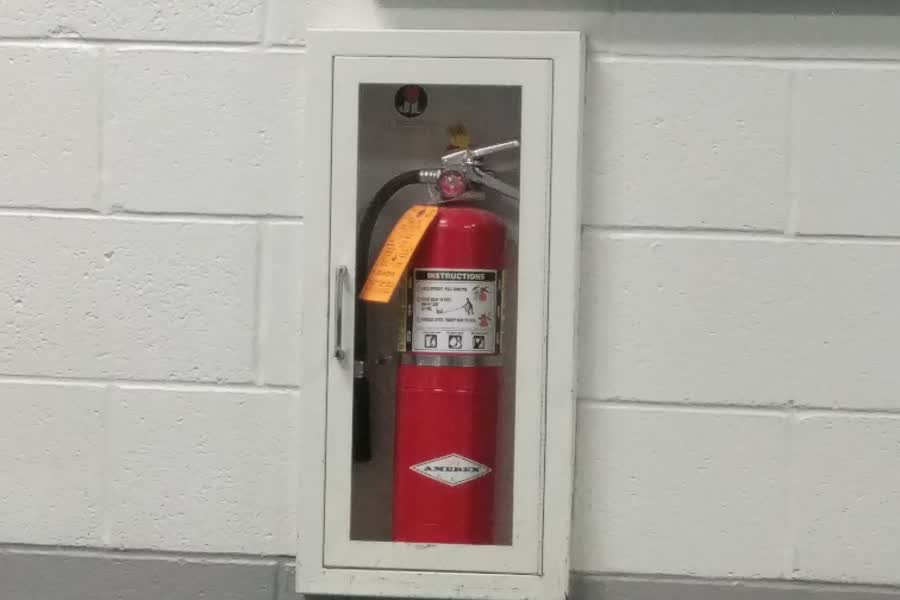
Most commercial buildings have fire extinguishers hanging on the walls, and most building managers assume that because the extinguishers are there, the building is covered. The fire code disagrees. An extinguisher is only considered serviceable if it has been inspected on a schedule, by the right people, with the results recorded, and a surprising number of facilities fail their fire inspection not because an extinguisher is missing but because the tag shows it has not been checked.
The schedule has two main layers that are frequently confused: a quick monthly check that the facility’s own staff can and should perform, and an annual maintenance inspection that must be done by a qualified technician. They involve different tasks, different people, and different documentation. This guide separates them, explains what each catches, and covers the longer-interval maintenance that sits behind both.
The Standard Behind the Schedule
Portable fire extinguisher inspection and maintenance in the United States follows NFPA 10, the Standard for Portable Fire Extinguishers, which most state and local fire codes adopt by reference. NFPA 10 sets the inspection intervals, defines what each inspection includes, specifies who may perform maintenance, and requires that results be recorded on a tag attached to the extinguisher and in the facility’s records. Local fire marshals enforce it during their inspections, and insurers often ask for the records after a claim.
The Monthly Inspection
Who does it
The monthly inspection is a visual check that the facility’s own personnel are permitted to perform. It does not require a technician. In practice it is assigned to a facilities person, a safety coordinator, or a manager, and the main requirement is that it actually gets done every month and gets recorded.
What it covers
- Location. The extinguisher is in its designated place, mounted or in its cabinet, and has not been moved, borrowed, or left on the floor.
- Access. Nothing is blocking it. Stock, furniture, carts, and holiday decorations in front of extinguishers are among the most common findings in fire inspections.
- Visibility. The extinguisher or its sign is visible from a reasonable distance; it has not been hidden by a new display or a relocated partition.
- Pressure. The gauge needle is in the green operable range, where the extinguisher has a gauge.
- Physical condition. No obvious damage, corrosion, leakage, or clogged nozzle.
- Pin and seal. The pull pin is in place and the tamper seal is intact. A broken seal means the extinguisher may have been discharged, even briefly, and it needs service.
- Weight or heft for extinguishers without gauges, such as carbon dioxide and some cartridge-operated units, by lifting to confirm it feels full.
- Tag. The annual inspection tag is present and the last annual date is within the past twelve months.
How it is recorded
The person performing the check initials and dates the tag or a monthly inspection record. Many facilities use a log sheet or a software system; the tag itself usually has spaces for monthly initials. The record must exist, because an inspector who sees a tag with no monthly entries will cite it regardless of the extinguisher’s condition.
What it catches
The monthly check catches the problems that arise from daily operations: the extinguisher that was moved during a renovation, the one blocked by a pallet, the one someone discharged on a trash can fire and hung back up, the one whose gauge dropped after a slow leak. These are the failures most likely to matter in a real fire, and they appear between annual visits.
The Annual Maintenance Inspection
Who does it
Annual maintenance must be performed by a trained and certified person, which in practice means a fire protection technician from a licensed service company. The technician has the training, tools, replacement parts, and record-keeping that the standard requires, and the facility’s own staff are not permitted to perform or sign off on this level of maintenance.
What it covers
The annual inspection is a thorough examination of the extinguisher’s mechanical parts, extinguishing agent, and expelling means. The technician:
- Performs everything in the monthly inspection.
- Examines the cylinder, hose, nozzle, handle, lever, and valve for damage, corrosion, and wear.
- Verifies the gauge reads correctly and the pressure is within range, or weighs the extinguisher against its rated weight for gaugeless types.
- Checks the agent condition where applicable, and for dry chemical units confirms the agent has not caked by inverting or otherwise agitating the unit.
- Inspects the hose and nozzle for obstruction and replaces worn parts.
- Confirms the extinguisher is the correct type and size for the hazard where it is located and that it is mounted at the proper height.
- Verifies that the extinguisher is within its six-year maintenance and hydrostatic test intervals, and schedules or performs those services if due.
- Replaces the tamper seal and attaches a new annual tag showing the date, the technician, and the service company.
- Records the inspection in the facility’s maintenance records and often provides a written report listing every unit, its condition, and any deficiencies.
What it catches
The annual inspection catches what a visual check cannot: internal corrosion, a gauge that reads full on a unit that has lost pressure, caked agent that will not discharge, deteriorated hoses, and extinguishers that are the wrong type for the hazard they are protecting. It also catches the schedule items, the six-year maintenance and hydrostatic test, that a facility would otherwise overlook entirely.
The Longer Intervals Behind the Annual
Two further services sit on multi-year schedules, and the annual inspection is where they are tracked.
Six-year maintenance applies to stored-pressure dry chemical extinguishers. Every six years the extinguisher is emptied, internally examined, refilled, and repressurized, with a label recording the service. This is a shop procedure, not a field one.
Hydrostatic testing pressure-tests the cylinder itself to verify it can still hold pressure safely. The interval depends on the extinguisher type: commonly twelve years for stored-pressure dry chemical units and five years for carbon dioxide, water, and some others. A cylinder that fails is condemned. The test is performed by a service company with the proper equipment and recorded on a label or collar.
Both of these are easy to miss without a technician tracking them, which is the practical reason the annual inspection is required to be professional.
Reading the Tag
The tag on an extinguisher tells the whole story to anyone who knows how to read it: the service company and technician, the month and year of the last annual inspection, the monthly initials since, the date of the last six-year maintenance, and the hydrostatic test date, which may be on a separate label or collar. A fire inspector reads the tag first. A facility manager should learn to as well, because a tag with a lapsed annual date or no monthly initials is a citation waiting to happen, and a tag that shows everything current is the best evidence a facility can present.
Getting Both Layers Right
The monthly check is the facility’s job, and the fix for most monthly failures is a named person, a calendar reminder, and a log. The annual inspection is the service company’s job, and the fix is a company that tracks the schedule, shows up before the tag lapses, performs the full procedure rather than a tag swap, and provides reports the facility can hand to an inspector or insurer.
In Wyoming, Crimson Fire Protection provides fire extinguisher inspection and maintenance to NFPA 10 for commercial and industrial facilities across Casper and the surrounding counties, with annual tagging and written reports, six-year maintenance and hydrostatic testing on a tracked schedule, location maps that make a facility’s monthly checks easier to perform and record, loaner units during service so coverage is never interrupted, and coordination with local fire inspectors on placement and signage. For a facility anywhere, the standard to hold a service company to is the same: full annual procedures rather than a tag change, the multi-year intervals tracked and performed, and documentation that reads clearly to the inspector.
Key Takeaways
- NFPA 10 governs extinguisher inspection and is enforced by local fire marshals and relied on by insurers.
- The monthly inspection is a visual check that facility staff perform and record: location, access, pressure, pin and seal, condition, and tag.
- The annual inspection must be done by a trained, certified technician and covers mechanical parts, agent, pressure, suitability for the hazard, and the multi-year schedule.
- Six-year maintenance and hydrostatic testing sit behind the annual and are tracked by the technician.
- The tag records all of it and is what the inspector reads first.
- Assign a named person to the monthly check; hire a service company that performs the full annual procedure and tracks the long intervals.
Frequently Asked Questions
Can my own staff do the monthly extinguisher inspection?
Yes. The monthly check is a visual inspection that facility personnel are permitted to perform, provided it is done every month and recorded with initials and a date.
Can my staff do the annual inspection too?
No. Annual maintenance must be performed by a trained and certified person, which in practice means a technician from a licensed fire protection service company.
What happens if the monthly checks are not recorded?
A fire inspector who sees a tag without monthly entries will typically cite the facility, regardless of the extinguisher’s actual condition. The record is part of compliance.
What is the difference between the annual inspection and six-year maintenance?
The annual is a thorough external examination and function check done in place. Six-year maintenance, for stored-pressure dry chemical units, empties and internally examines the extinguisher in a shop, then refills and repressurizes it.
How often is hydrostatic testing required?
It depends on the extinguisher type: commonly twelve years for stored-pressure dry chemical and five years for carbon dioxide, water, and some others. The service company tracks the date and performs the test.
What should I look for on an extinguisher tag?
The service company and technician, the last annual date, the monthly initials since, the six-year maintenance date, and the hydrostatic test date on the tag or a separate label. All should be current.
Conclusion
Fire extinguisher compliance is two habits working together: a monthly look by someone in the building, and an annual visit from someone trained to see what the look cannot. Neither replaces the other, and a facility that does one without the other is exposed. Assign the monthly check, hire the annual properly, and the tag on every extinguisher becomes what it is supposed to be: proof that the equipment will work when it is needed.