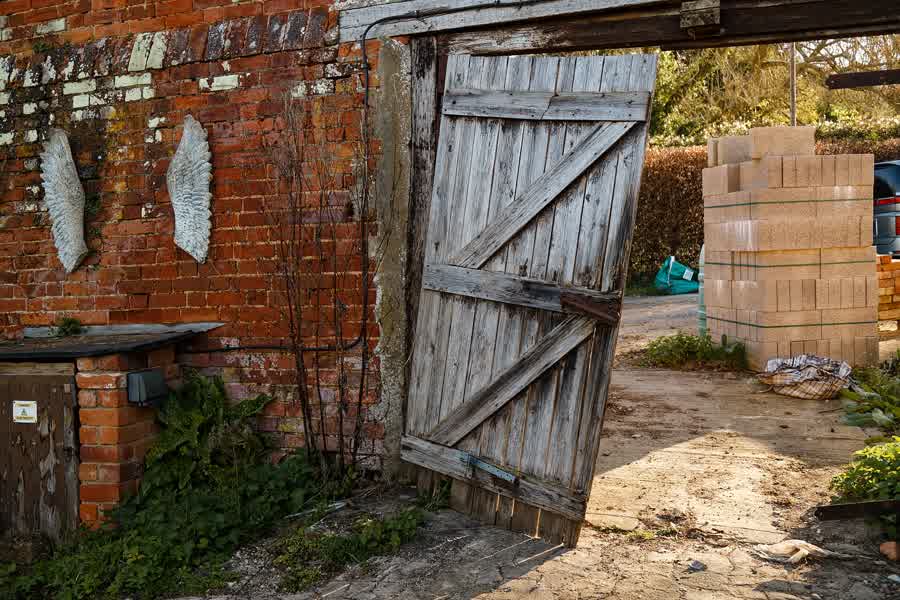
A fence rarely fails all at once. It leans a little, a board loosens, a gate drags, rust shows at the base of a picket, and the owner notices each one and sets it aside until the day the fence is visibly a problem. By then the question is not whether something must be done but what: a repair that fixes the symptom, a repair that fixes the cause, or a replacement that stops the sequence. The answer depends on the material, the symptom, and how many times the same symptom has already been addressed.
This guide reads a fence the way a repair contractor does: by material, by what the symptom says about the cause, by whether the cause can be corrected in place, and by whether the arithmetic of repeated repair has already crossed into replacement territory.
Wood Fences
Leaning sections
A leaning wood fence is a post problem. Either the post has rotted at the ground line, the footing was set too shallow and has heaved with frost, or the concrete has cracked and the post is loose. Pushing the fence upright and bracing it does nothing; the post has to be reset or replaced. A single leaning post with the rest sound is a repair. A fence where half the posts are moving was set wrong or has reached the end of its post life, and resetting every post is most of a replacement.
Rot
Rot in pickets and rails is repairable board by board. Rot in posts, especially at the ground line where it is invisible until the post snaps, is the fence’s structural failure. A screwdriver pushed into a post at grade tells the story: firm wood is fine, soft wood is a post that needs replacing. If several posts are soft, the fence is at the end of its life.
Loose or missing boards, broken rails
Routine repair. Boards are replaced individually, rails are replaced per section, and fasteners that have rusted are replaced with galvanized or stainless. New cedar or treated pine will not match weathered wood for a season or two; staining the whole fence afterward evens it out.
Sagging gates
Almost always a brace, hinge, or post problem rather than a gate problem. A diagonal brace that was never installed or has loosened, hinges too light for the gate, or a gate post set shallow. All three are repairable; the post is the one that costs.
When to replace a wood fence
When several posts are rotted or heaving; when rot has spread through rails and boards across multiple sections; when the fence was built from an undersized or untreated post and is failing uniformly; or when the fence is near the end of its expected life and repair costs are approaching replacement. A wood fence that needs more than a few posts replaced is usually better rebuilt on new posts set correctly.
Wrought Iron and Steel Fences
Rust at the base
Iron and steel fences rust where water sits: at the base of pickets where they meet the bottom rail, at the bottom rail itself, at welds, and at posts near the ground. Surface rust with the metal still solid is a maintenance repair: scrape, wire-brush or blast to sound metal, prime, and paint. Rust that has pitted or thinned the metal, or that has eaten through a picket or rail, is a structural repair: the section is cut out and new metal welded in, then the whole fence is refinished.
Loose posts
Iron posts in masonry or concrete loosen when water enters the connection, freezes, and cracks the surrounding material, or corrodes the embedded post. The post is re-set in fresh grout or anchoring compound, or replaced if the embedded section has corroded. A fence with one or two loose posts is a repair; a fence where posts are loosening along its length has a systemic water problem at its base and needs the bases rebuilt.
Broken or bent pickets and scrollwork
Impact damage from vehicles, falling branches, or vandalism. A fabricator cuts out the damaged section and welds in matching pieces, which with custom ironwork means forging or reproducing the original detail. This is routine for a shop with ironwork capability and nearly impossible for one without.
Gates that drag or will not latch
Hinge wear, a sagging gate frame, or a gate post that has moved. Hinges are replaced, frames are squared and re-welded, posts are reset. An automated gate that has stopped working is usually an operator or sensor problem rather than a gate problem, and is diagnosed separately.
Failed finish
Chalking, peeling, and widespread surface rust on an otherwise sound iron fence is not a structural problem; it is a repainting job, and doing it before the rust pits the metal is what keeps the fence out of the structural category. A fence that has gone decades without paint will need heavy preparation, but if the metal is sound it is still a repaint rather than a replacement.
When to replace an iron fence
Rarely, and only when rust has thinned the metal along most of the fence, when posts have corroded off at the base across many sections, or when the fence is so damaged that reproducing it costs more than building new. Iron fences are the most repairable fence type, and a well-equipped shop can keep one in service indefinitely.
Chain Link Fences
Sagging fabric
The fabric has lost tension, usually because a tension band or wire has failed, a terminal post has shifted, or the fabric was never stretched properly. Re-tensioning is a straightforward repair if the posts are sound.
Bent or leaning posts
Impact or frost heave. Individual posts are replaced; posts heaving along the line were set shallow and the fence needs its footings redone.
Damaged fabric
Cut, torn, or rusted sections are replaced by unweaving the damaged span and weaving in new fabric. The new section will not match weathered galvanized exactly, which matters on a residential fence and not at all on a commercial one.
Rusted framework
Surface rust on galvanized pipe is cosmetic; rust-through at the base of posts is structural. Chain link is the one fence type where replacement is often cheaper than extensive repair, because the material cost is low and the labor of partial repair is high.
Aluminum and Vinyl Fences
Aluminum does not rust, so its failures are impact and fastener-related: bent pickets, cracked panels, and loosened connections, repaired by replacing the panel or section. Vinyl cracks in cold weather and under impact, and its panels are replaced rather than repaired; matching older, faded vinyl is the main difficulty.
The Arithmetic of Repeated Repair
The hardest decision is not the first repair but the third. A fence that has needed a post reset, then another, then a rail, is telling the owner something about its posts, and the owner who keeps paying for repairs is paying for a replacement in installments. Two tests help.
- Is the cause being fixed or the symptom? A post reset fixes the cause of a lean. A board replaced on a fence whose posts are rotting fixes a symptom and will be followed by another.
- What is the cumulative repair cost against replacement? When the repairs of the past two years, plus the one being quoted, approach half the cost of a new fence of the same type, replacement is usually the better value, since it resets the fence’s life rather than extending the old one briefly.
What to Expect From a Repair Contractor
A good repair contractor assesses before quoting, names the cause rather than the symptom, says plainly when replacement is the better answer, matches the existing material and design so the repair does not announce itself, and finishes the repair so it lasts: new boards stained, new iron primed and painted, new fabric tensioned. For iron and custom work, the contractor needs fabrication capability, because a damaged scroll cannot be ordered from a catalog.
In Chicago, Americana Iron Works & Fence has provided fence repair services for wrought iron, wood, aluminum, and chain link fences for more than thirty years, assessing the damage before quoting, reinforcing and removing rust on iron with in-house ironwork to reproduce matching sections and custom gates, replacing rotted posts and boards on wood, and completing most minor repairs within a day, with a recommendation on repair versus replacement made after inspection rather than before, as a licensed, bonded, and insured contractor. For an owner anywhere, the contractor to call is the one who will tell them when not to repair, because that honesty is the only way to know the repairs they do recommend are worth paying for.
Key Takeaways
- A leaning wood fence is a post problem; rot in posts at grade is the structural failure, and several soft posts mean replacement.
- Iron fences rust where water sits; surface rust is a repaint, pitting or rust-through is a weld repair, and iron is the most repairable fence type.
- Chain link sags from lost tension and heaves from shallow posts; extensive chain link repair is often costlier than replacement.
- Aluminum and vinyl are repaired by panel replacement; matching faded material is the challenge.
- Ask whether a repair fixes the cause or the symptom, and compare cumulative repair cost to replacement.
- Hire a contractor who assesses first, matches the existing work, has fabrication capability for iron, and will say when replacement is the better answer.
Frequently Asked Questions
Can a leaning fence be fixed without replacing it?
If the lean is from one or two bad posts, yes; those posts are reset or replaced. If posts are moving along the fence, the footings were set wrong or have reached the end of their life, and resetting all of them approaches a replacement.
Is a rusty iron fence beyond repair?
Almost never. Surface rust is removed and the fence repainted. Rust that has eaten through a section is cut out and new metal welded in. Only widespread thinning along the whole fence argues for replacement.
How do I check if a wood fence post is rotten?
Push a screwdriver into the post at ground level. Firm wood is sound; soft, spongy wood is rot, and the post should be replaced before it fails.
Why does my fence gate drag on the ground?
A loose or missing diagonal brace, worn or undersized hinges, or a gate post that has shifted. All are repairable; the post is the one that requires digging.
Can a damaged section of a custom iron fence be matched?
Yes, by a fabricator with ironwork capability who can forge or reproduce the original detail. A contractor without a shop cannot match custom work and will propose replacing more than is needed.
When does repairing a fence stop making sense?
When repairs are addressing symptoms rather than the cause, or when the cumulative cost of recent and quoted repairs approaches half the cost of a new fence. At that point replacement resets the fence’s life rather than extending it briefly.
Conclusion
Every fence problem has a cause, and the cause decides whether a repair is a fix or a delay. Posts and bases are where fences fail, in every material, and a repair that addresses them lasts while one that addresses only the board, the rust spot, or the gate does not. An owner who reads the fence this way, and who hires a contractor willing to say when the answer is replacement, spends less over the fence’s life and spends it once.


