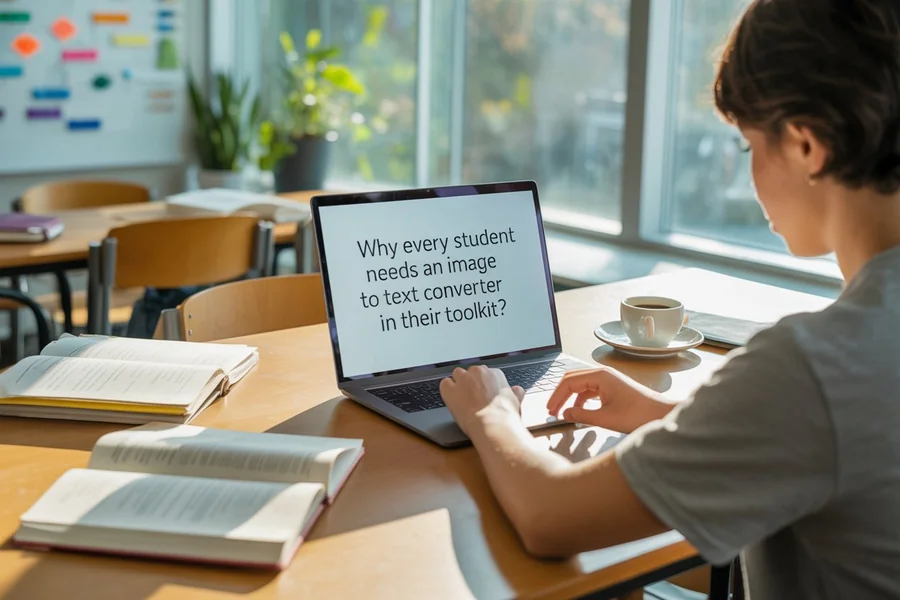
Today’s students are brighter than ever, and technology has played a vital role in enhancing their intelligence. They now utilize advanced tools while studying to make their learning experiences seamless, not only in learning but also in organizing and preserving materials.
Among these tools, one has garnered considerable attention in recent years. Yes, we are talking about image-to-text converters. Many students are using them to handle their learning materials, such as notes, printed papers, and other study materials.
Upon exploring, we found these tools to be so helpful that every student should have them in their toolkit.
Want to know why?
Stick along and read this article to the end, as you are about to explore the benefits students can gain from having an image-to-text converter tool in their toolkit.
What Actually is An Image Text Converter Tool?
Image-to-text converters are actually tools powered by OCR technology. That is why you often hear them referred to as OCR tools. This OCR (optical character recognition) technology specializes in detecting and extracting readable text within images. Combined with AI, many image-to-text converters, such as Imagetotextconverter.net and Imagetotext.me, are now becoming a popular choice among students. Using these tools, they can now extract text from images, digitize their handwritten notes, preserve antique pieces, and utilize them for various other tasks as well — especially when enhancing visuals beforehand by adding text to an image to make them more descriptive or easier to sort digitally.
Combined with AI, many image-to-text converters, such as Imagetotextconverter.net and Imagetotext.me, are now becoming a popular choice among students. Using these tools, they can now extract text from images, digitize their handwritten notes, preserve antique pieces, and utilize them for various other tasks as well.
The most valuable feature of the OCR tools mentioned is their ability to understand and extract handwritten text. As you know, handwritten notes, tips, and tricks from class lectures are among the most valuable assets for students.
Moreover, image-to-text converter tools not only extract text from images but also enable students to save them in a well-organized manner in digital file formats.
Why Students Should Use an Image to Text Converter?
Now you know what image-to-text conversion tools are and what they do. Now, let’s discuss why, as a student, you should have them in your toolkit.
Saves Valuable Study Time
Typing things manually while watching images or handwritten notes is among the repetitive tasks for students. Manually typing things is not only time-consuming but also prone to errors, such as missing crucial elements and grammatical and spelling mistakes.
That is where image-to-text converters come as a handy tool. Using them, students can quickly turn their text into digital file formats, both editable and non-editable (susceptible to the tool in use).
All students need to provide the tool with the images of the text they want to type. That’s it. The text they might spend hours typing will be instantly converted to a digital file format.
Helps in Organizing Study Material
Managing study materials in physical form is a challenging task for today’s students. Most of them today expect and prefer things to be in digital form. That is where they can utilize an image-to-text converter to digitize their learning materials, books, handouts, and other documents.
By digitizing study materials using an image-to-text converter, students gain the following benefits.
- Resources become easier to store and categorize.
- Information retrieval becomes easier.
- Things become accessible while on the go.
- Enable sharing notes with classmates in editable formats.
- Makes the online collaborative study easier.
Accessibility Benefits
Another reason students should keep an image-to-text converter in their toolkit is the accessibility it provides. These tools are not only helpful for managing study materials but also play a vital role in making learning easier for students who are differently abled or have visual difficulties.
For instance, when the extracted text is converted into a digital format, it can be easily used with text-to-speech software. This allows visually impaired students to listen to study materials instead of struggling to read them.
In this way, an image-to-text converter bridges the gap between traditional learning resources and accessible education.
In a Nutshell
Image-to-text converters make many tasks easier for students. They help in digitizing, preserving, and organizing study materials. They prevent typographical errors and save students’ time, allowing them to spend more time learning instead of typing.
The reasons for having OCR tools in the toolkit we discussed above are numerous. Many are uniquely using these tools for different purposes. Above all, the advantage of these tools is that most of them are free to use.
As a student, you can give these tools a try. They may provide you with benefits in a way that you have never thought of.